TL;DR
Adjustable dumbbell sets combine multiple weight options in one compact set, saving space while letting you change resistance between exercises. Before buying, match the weight range and increments to your workouts, then compare the grip, dimensions, adjustment system, storage, and warranty.
A pair of adjustable dumbbells can take the place of a crowded rack, but the wrong pair can make a simple workout feel like a wrestling match with a toolbox. The difference often comes down to details you notice only after the first few sets: how much the load jumps, how the handle sits in your palm, and how quickly you can change weight.

Get workout gear delivered free with Prime
- Fast, free delivery on millions of items
- Prime Video, Amazon Music and more included
- Member-only deals all year
Adjustable dumbbell sets combine multiple weight options in one compact set, using dials, pins, levers, or removable plates. They can suit a spare room, apartment corner, or garage gym, but designs vary in weight range, size, adjustment speed, and durability. This guide gives you the key facts for comparing them, choosing a set for your exercises, and caring for its locks and plates.
Think of your workout space as a small kitchen: a versatile tool earns its place when it works for the jobs you actually do. If you switch between light lateral raises and heavier rows, you need more than a big maximum number. You need adjustments that fit your routine and feel secure in your hands.
Adjustable dumbbells can replace many fixed pairs and free space, but their dimensions still need to fit your exercises and room.
Compare the minimum and maximum load per dumbbell as well as the size of each weight increment.
Dial and selector models often change faster; plate-loaded sets generally take longer but can have simpler mechanics.
Before purchase, check grip, balance, bench clearance, expansion options, warranty, and replacement part availability.
Change weights on a stable surface, confirm locks are engaged, and follow the maker’s directions about dropping and storage.
Save floor space without giving up workout variety
Adjustable dumbbell sets put several selectable loads into a pair of handles, so you can train at different weights without lining up many fixed pairs. A compact set can free floor space for a bench or yoga mat, while still supporting exercises such as curls, presses, and rows. The exact range depends on the model.
For instance, if you exercise in a small apartment, you might keep a pair and its trays under a sturdy bench, then pull them out for a 30-minute session. One weight could suit shoulder raises; a heavier setting could suit goblet squats. The room stays clear between workouts, and you avoid carrying a stack of separate dumbbells from a closet.
Adjustable dumbbells combine multiple weight options in one compact footprint, but that convenience has tradeoffs. A long or block-shaped dumbbell can feel unlike a traditional round one, especially in movements where you bring the weights close to your shoulders. And a pair that stores neatly may still need enough clearance to lift safely.
They may also reduce the cost and clutter of buying many fixed pairs, though premium selector systems can cost more upfront. Think about your actual routine: if you train in one spot and switch weights often, convenience matters. If you mostly use one heavy load, the extra adjustment mechanism may matter less.
Products Worth Considering

Therabody Theragun Relief Massage Gun, 3-Speed, Navy

Garmin Forerunner 970 GPS Running and Triathlon Smartwatch, 47 mm, Titanium, Whitestone/Amp Yellow

Withings Body Smart Wi-Fi and Bluetooth Body Composition Scale
As an affiliate, we earn on qualifying purchases.
Pick an adjustment style that fits your workout rhythm
Dial and selector systems usually change weight quickly while the dumbbell rests in its cradle; pin and lever systems use a selector to lock plates; plate-loaded sets require you to add or remove plates and secure collars. Each style trades speed, simplicity, and mechanical complexity differently, so the best choice depends on how often you switch loads.
| Style | What feels convenient | What to check |
|---|---|---|
| Dial or selector | Quick weight changes between exercises | Cradle fit, selector operation, and care instructions |
| Pin or lever | Relatively straightforward selection | That the pin or lever is fully engaged |
| Plate-loaded | Simple mechanical design and often lower cost | Time to change plates and secure collars |
| Block-style | Compact, selectable load | Shape and dimensions during movements |
Imagine you alternate a light set of curls with a heavier row. A dial may make that transition quicker; with a plate-loaded set, you’ll spend more time changing plates. On the other hand, if your workout uses the same weight for several movements, speed may not matter much.
Try the adjustment process before buying if you can. Check whether the dumbbell must sit in a cradle, whether the controls feel clear, and whether you can tell at a glance that a pin is seated. A fast change is useful only when the selected plates stay locked during the lift.
Match the weight range and increments to the lifts you do
Choose a weight range that covers your current exercises and leaves room for gradual progression, then check the load added at each adjustment. The maximum weight alone does not tell you whether a set will work well. Small increments can help when a bigger jump feels awkward on lighter movements.
For example, a lifter may row comfortably at a heavier load but find the same increase too much for shoulder raises. If the available selector jumps are large, they may have to repeat the lighter setting for longer or change the exercise. Someone focusing on presses and rows may value a higher maximum more than someone who mostly does light accessory work.
Weight range means the lowest and highest load per dumbbell; increments show how much each change adds. Check both numbers and whether the set accepts add-on plates. Some models expand; others stop at their listed maximum. If you expect to get stronger over time, expansion can affect the set’s longer-term value.
Before shopping, write down a few exercises and the loads you currently use or expect to use. A beginner who trains at home might start with manageable weights for presses, curls, and squats, while planning to add load gradually. If you have a pre-existing condition or are unsure what loading is appropriate for you, ask a qualified professional for guidance before starting a new routine.
Check how the grip and shape feel during real movements
Grip, balance, handle length, and overall dimensions affect how a dumbbell feels in your hand and moves around your body. Adjustable models can be longer or bulkier than fixed dumbbells at the same load, so a high weight range does not guarantee a comfortable fit for every exercise.
Try to imagine a floor press: as you lie back, the ends of the weights need room to move beside your shoulders. A long dumbbell may bump your arms or bench, while a squared-off block design may feel unfamiliar during curls. That does not make the shape unsuitable; it means your own movement and available clearance count.
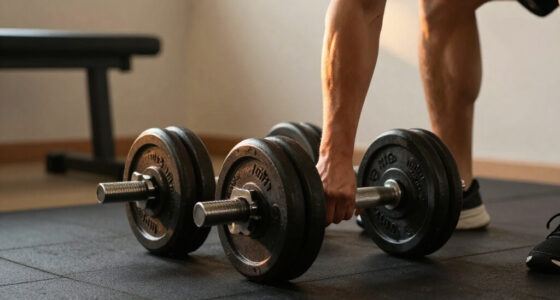
Handle diameter and knurling affect how securely you can hold the weight, especially if your palms get sweaty. Plate placement affects balance, and a long handle may feel different during one-arm movements. If a shop has a demo model, hold it at your sides, curl it, and rehearse the path of a press without lifting beyond your comfort.
At home, measure the space around your bench and where you plan to store the set. For instance, a dumbbell may fit neatly under a desk but prove awkward to lift out if the clearance is tight. A few minutes with a tape measure can save you from learning that lesson mid-workout.
Use this five-step check before you buy
Compare adjustable dumbbell sets by checking your exercises, required loads, adjustment steps, physical fit, and ownership details in that order. This quick process keeps a flashy selector or large maximum number from overshadowing the features you will use every week.
- List your main lifts. Write down the exercises you plan to do, such as rows, presses, curls, and squats.
- Compare weight and increments. Check the starting load, maximum per dumbbell, and size of each jump.
- Test the adjustment. See whether you use a dial, pin, lever, or collars, and how securely it engages.
- Measure the fit. Check handle length, overall dimensions, bench clearance, and storage space.
- Read the ownership details. Look at the materials, warranty, replacement parts, stand or tray, and manufacturer instructions.
For instance, a buyer who trains in short sessions before work may favor quick changes, while someone lifting in a garage with time between sets may accept plate changes to get a simpler design. The same set does not suit both routines equally well.
Current models, prices, warranties, and availability change, so confirm those details with the seller before purchase. A set that can accept expansion plates may seem like a smart long-term choice, but check whether those plates are available separately and what they cost. A useful buying rule is simple: match range and increments to your lifts, then compare fit, safety, and support.
Keep selector parts safe with a simple care routine
Change the load with the dumbbell on its cradle or another stable surface, then confirm that the selected plates are locked before lifting. Follow the maker’s directions for storage, impact, and maximum load, because many adjustable models are not designed to be dropped like some fixed dumbbells.
Suppose you finish a hard set and let the weights fall onto a concrete garage floor. The impact could damage a selector, lock, or plate even if the outside looks fine. Set the dumbbells down under control and return them to their trays or a stable storage spot instead.
Check locks and plates regularly for damage, and keep selector parts clean and dry according to the manufacturer’s care instructions. If a pin does not engage fully or a component looks damaged, stop using that dumbbell until you have checked the instructions or contacted the maker. Never try to compensate for a suspect lock by gripping harder.
Keep the workout area clear, too. A secure stand or tray can help keep the set organized, while suitable floor protection can reduce scuffs and noise. For example, a compact stand beside your bench can make the change from presses to rows smoother and give the plates a consistent home after training.
Frequently Asked Questions
Are adjustable dumbbells worth it compared with fixed dumbbells?
They can be worthwhile when you want several weights but have limited storage, since one pair can replace many fixed pairs. Fixed dumbbells may suit you better if you need very durable equipment for frequent drops or want a traditional shape at every weight. Compare the upfront price, storage, and exercises you do.
What weight range should I buy?
Choose a range that covers the exercises you do now and offers room to progress. Check the load per dumbbell and the size of each adjustment, since a maximum number does not tell you how useful the steps between loads will feel. If you have a pre-existing condition or need help selecting a safe training load, consult a qualified professional.
Are adjustable dumbbells suitable for beginners?
They can suit beginners because you can choose lighter loads for some exercises and increase resistance gradually. Learn the adjustment process, check the lock before lifting, and use loads you can control with good form. Ask a qualified professional for guidance if you have a pre-existing condition or concerns about beginning strength training.
Can I drop adjustable dumbbells after a set?
Do not assume you can. Many adjustable models have selector or locking parts that can be damaged by impact, so follow the manufacturer’s instructions and set the dumbbells down under control unless the maker explicitly says otherwise.
Do adjustable dumbbells feel balanced like regular dumbbells?
That depends on the model’s handle, plate placement, and dimensions. Some adjustable designs feel close to a traditional dumbbell, while longer or block-shaped models can feel different in curls or presses. If possible, handle a demo and check how it moves through the exercises you plan to do.
How quickly can I change the weight between exercises?
Dial and selector systems are usually quick to change while the dumbbell sits in its cradle. Pin and lever systems also allow selection, while plate-loaded sets take longer because you remove or add plates and secure collars. Your routine matters: fast changes help when you alternate loads often, but matter less when you keep one weight for several sets.
Conclusion
Choose your set by starting with the lifts you plan to do: match their loads and increments, then check that the grip, shape, and adjustment steps suit your space and routine. A smaller, well-fitting range can serve you better than a heavier set that feels awkward on half your exercises.
Look for a pair that fits your hands, your workout, and the corner where it will live. Then put it to work—and leave enough clear floor to move with confidence.