TL;DR

Get workout gear delivered free with Prime
- Fast, free delivery on millions of items
- Prime Video, Amazon Music and more included
- Member-only deals all year
Physical therapist Devin Trachman recommends the sit-to-stand as a practical strength exercise for people looking to support walking and everyday mobility. Fit&Well’s report gives a suggested routine of two to three sets of eight to 10 repetitions, with modifications for people who need support. The recommendation is expert guidance, not evidence that one exercise works for everyone.
Physical therapist Devin Trachman recommends the sit-to-stand as a strength exercise that can support walking and everyday mobility, according to a Fit&Well report. The exercise involves rising from a chair and sitting back down with control, and the report suggests two to three sets of eight to 10 repetitions.
Trachman, identified by Fit&Well as the clinical director of Physical Therapy Central in West Edmond, Oklahoma, said chair stands build lower-body strength used in movements such as walking, climbing stairs and getting up independently. The exercise primarily targets the quadriceps and gluteus maximus, while also engaging core stabilizers, the report says.
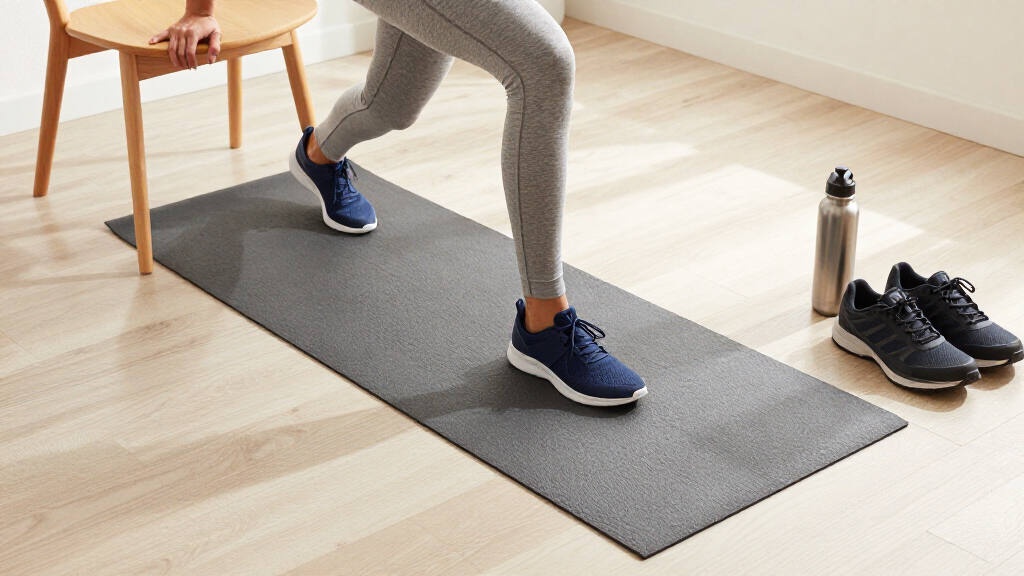
The instructions call for sitting near the front of a sturdy chair with feet flat and about shoulder-width apart. The person leans the chest slightly forward while keeping the back straight, pushes through the heels to stand upright, then lowers back into the chair slowly. Fit&Well lists 60 seconds of rest between sets and advises avoiding hand support if that can be done safely.
For people who need assistance, the report suggests a chair with armrests for light support or a sturdy surface in front of them. Trachman’s recommendation is a general exercise suggestion; the article does not report a clinical trial testing this routine or establish that it is suitable for every person or every cause of walking difficulty.
Strength for Everyday Walking
The recommendation focuses on a practical movement that many people already perform: standing up from a chair. Building strength for that action may also help with other daily tasks that depend on the legs, including stair climbing and rising from a seated position. The relevance is not that sit-to-stands replace walking, but that strength work can be one way to address physical demands that make walking feel harder.
Trachman told Fit&Well that inactivity, pain or walking becoming more tiring can lead people to reduce their activity. She described a possible cycle in which reduced activity is followed by weaker muscles, lower balance and endurance, and greater difficulty walking. Her view is that strength exercises may help people build confidence and capacity to remain active. These are expert comments, not a guarantee of improved walking or independence for any individual.
For readers, the practical takeaway is to choose a version of the movement they can perform with control and appropriate support. People with pain, balance problems, recent injuries or health conditions may need advice from a clinician or physical therapist before starting or changing an exercise routine.
chair sit-to-stand exercise equipment
As an affiliate, we earn on qualifying purchases.
As an affiliate, we earn on qualifying purchases.
The Report’s Exercise Guidance
Fit&Well frames the recommendation around age-related changes in muscle mass and mobility, while also noting that walking can become less comfortable for reasons including pain, reduced activity and lower endurance. The source does not say that age alone determines whether someone can walk well or remain independent. Trachman’s argument is that maintaining strength and confidence can be more useful than simply telling someone to walk more.
The expert named in the report is Dr. Devin Trachman, PT, DPT, MTC, OCS, a physical therapist and clinic director at Physical Therapy Central’s West Edmond location. Fit&Well’s biographical note says she earned her physical therapy doctorate from the University of Oklahoma Health Sciences Center and became an orthopaedic clinical specialist in 2024.
The quoted description of sit-to-stands as the exercise she would choose if limited to one is a personal professional recommendation. The source material provides a suggested routine and form cues, but no comparative evidence showing that sit-to-stands outperform other exercises for walking or that the listed repetitions are appropriate for all readers.
“If I could only prescribe one exercise to improve walking, this would be it.”
— Devin Trachman, clinical director of Physical Therapy Central, as quoted by Fit&Well
sturdy kitchen or office chair with armrests
As an affiliate, we earn on qualifying purchases.
As an affiliate, we earn on qualifying purchases.
Limits of the Recommendation
The report does not provide a publication date, details of a study evaluating the exercise, or evidence comparing sit-to-stands with other strength or balance routines. It also does not establish how much the exercise improves walking, how quickly changes might occur, or whether the suggested sets and repetitions are suitable for people with different abilities or medical histories.
It remains unclear whether the recommendation is intended for people with a particular diagnosis or level of mobility. The source offers basic modifications but does not describe individualized assessment. Anyone who has pain, feels unsteady, or has a condition that affects exercise tolerance may need tailored guidance from a health professional before attempting the movement.
exercise guide for lower body strength
As an affiliate, we earn on qualifying purchases.
As an affiliate, we earn on qualifying purchases.
Choosing a Safe Starting Point
Fit&Well’s report presents sit-to-stands as an accessible starting point, with armrests or a sturdy support available for people who cannot rise without help. Readers considering the routine can follow the report’s form cues, begin with a version they can control, and stop if they experience concerning pain or feel unsafe. The article does not set out a progression schedule or a follow-up assessment.
For people whose walking has changed or become difficult, the next step may be to discuss the cause and appropriate activity level with a physical therapist or other qualified clinician. No additional study, official guidance or follow-up from Trachman is specified in the source material, so the recommendation should be understood as general advice rather than a personalized treatment plan.
As an affiliate, we earn on qualifying purchases.
Key Questions
What exercise does the physical therapist recommend?
Devin Trachman recommends the sit-to-stand: rising from a chair and lowering back down with control. Fit&Well reports her view that the movement can build strength used in walking and other everyday activities.
How many sit-to-stands does the report suggest?
The report lists two to three sets of eight to 10 repetitions, with 60 seconds of rest. That is general guidance from the article, not an individualized prescription.
What if I need my hands to stand up?
Fit&Well suggests using a chair with armrests for light support or placing a sturdy support in front of you. If standing feels unsafe or causes pain, seek advice from a qualified clinician rather than pushing through.
Does the report prove sit-to-stands improve walking?
No. The source presents Trachman’s professional recommendation and exercise instructions, but does not cite a trial or comparative evidence demonstrating a specific improvement in walking.
Source: rss
Halloween Picks
halloween
As an affiliate, we earn on qualifying purchases.