TL;DR

Get workout gear delivered free with Prime
- Fast, free delivery on millions of items
- Prime Video, Amazon Music and more included
- Member-only deals all year
Boston-based Pilates instructor Julie Erickson recommends a three-move sequence—roll up and down, swan prep and spine twist—for people looking to work on mobility and back strength. Those benefits and the claim that it is the quickest way to improve posture come from the instructor’s guidance; the report provides no trial or comparison showing how quickly it works.
Boston-based Pilates instructor Julie Erickson, founder of Endurance Pilates and Yoga, recommends a three-exercise sequence for people who want to work on posture and stiffness after long periods at a desk or looking at a phone. The Fit&Well report presents the routine as a way to build mobility and back strength, but provides no comparative evidence that it is the quickest route to improvement.
The sequence consists of a roll up and roll down, a swan prep and a seated spine twist. Fit&Well attributes the recommendation to Erickson. Its suggested repetition counts are eight to 10 roll-ups, five swan preps and five twists on each side. The report says regular practice may help restore mobility and strengthen the back, making upright sitting and standing easier; these are the instructor’s proposed benefits, not results demonstrated by research cited in the article.
For the roll-up, sit with legs extended and arms reaching forward. Inhale, tuck the tailbone and slowly roll down, reaching the arms overhead and then toward the ceiling. Exhale, engage the core and curl the head and chest up; then reach forward over the legs and return to sitting. The report suggests reducing the range by rolling down only halfway, or securing the feet under a strap or couch, to make the movement easier.
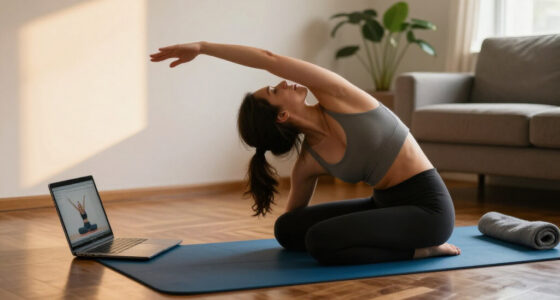
For swan prep, lie face down with palms beside the ribs and elbows bent. Press into the hands, lift the chest, draw the shoulders back and keep the neck long before lowering slowly. For the spine twist, sit with legs straight and arms extended sideways. Lengthen the spine and rotate the ribcage to one side while keeping the hips and lower back still; return to centre and repeat on the other side. The report advises five repetitions per side.
A Short Sequence for Desk Stiffness
The routine offers readers a specific, short sequence rather than a general instruction to move more. Its three exercises address different movements: rolling through the spine, extending the chest and rotating the torso. That can make the recommendation practical for people seeking a structured way to add movement to a day spent sitting, while the easier roll-up variation provides an adjustment for some beginners.
But the framing matters: the source does not report a study, measured posture changes or a comparison with other exercise plans. Readers should treat “quickest” as the article’s presentation of an instructor’s recommendation, not as a verified ranking or promise of rapid results. Individual ability and response can vary, and discomfort is a reason to stop rather than force a movement.
Pilates roll-up exercise equipment
As an affiliate, we earn on qualifying purchases.
As an affiliate, we earn on qualifying purchases.
How the Three Moves Fit Together
Fit&Well’s report links prolonged desk work and phone use with slouched posture and stiffness, then offers Erickson’s sequence as a practical response. It pairs a forward-and-back spinal movement with chest extension and seated rotation. The routine is therefore presented as a compact mobility and strength practice, not as a diagnosis or treatment for a specific condition.
The report includes modifications for the roll-up and a progression for swan prep: people who can do so may lift the chest higher or straighten the arms. It does not provide equivalent progressions for the twist, nor does it specify a weekly schedule, how long to continue the routine or a way to measure progress. Those gaps limit how precisely readers can apply the “quickest” claim.
“The three-move sequence is described as the “quickest way to improve your posture and reduce stiffness.””
— Julie Erickson, Pilates instructor and founder of Endurance Pilates and Yoga, as quoted in Fit&Well’s report
As an affiliate, we earn on qualifying purchases.
Evidence Behind the Speed Claim
The supplied report does not identify a study testing this sequence, quantify changes in posture or stiffness, or compare it with other exercises. It also does not define what “quickest” means, whether that refers to the time needed to complete the routine or the time to notice a change, or how frequently the exercises should be performed. No timeframe or expected result is established by the source.
Readers with back pain, limited mobility or another health concern should not assume the routine is suitable for them based on the article alone. The source gives exercise instructions but does not discuss screening, clinical advice or specific warning signs. It remains unclear whether Erickson’s recommendation was based on formal research, teaching experience or both.
seated spine twist Pilates accessory
As an affiliate, we earn on qualifying purchases.
As an affiliate, we earn on qualifying purchases.
What Readers Can Check Before Starting
The next step for readers interested in the sequence is to try the movements within a comfortable range and use the easier roll-up option if needed. The report gives no prescribed schedule, so it does not support a particular daily or weekly plan. Stop if a movement causes pain, and seek advice from a qualified health professional when a pre-existing condition or persistent symptoms could affect safe participation.
Further reporting or evidence would be needed to establish how quickly the routine changes posture or stiffness, how it compares with other approaches and which people are most likely to benefit. Until then, the three moves are best understood as an instructor’s suggested exercise sequence, not a proven fastest method.
As an affiliate, we earn on qualifying purchases.
Key Questions
Which three exercises are in the routine?
The sequence is a roll up and roll down, a swan prep and a seated spine twist. Fit&Well suggests eight to 10 roll-ups, five swan preps and five twists on each side.
Is this proven to be the quickest way to improve posture?
No comparative evidence is supplied in the report. “Quickest” reflects how the recommendation is framed; the source does not provide a study, timeline or comparison with other routines.
How can a beginner modify the roll-up?
The report suggests rolling down only halfway or securing the feet under a strap or couch. Keep the movement controlled and within a comfortable range.
How often should the routine be done?
The source says regular practice may help but does not set a weekly schedule or duration. It does not establish how soon someone might notice a change.
Should someone exercise through pain?
No. Stop if a movement causes pain. People with pre-existing conditions, persistent symptoms or concerns about mobility should seek guidance from a qualified health professional before starting.
Source: rss
Halloween Picks
halloween
As an affiliate, we earn on qualifying purchases.