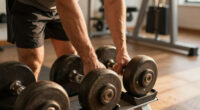
This guide helps beginners choose an adjustable dumbbell set, prepare a safe workout space, change the weight, and check the dumbbell before lifting. You will finish with a set that fits your training needs and a repeatable setup routine. Allow 30-60 minutes to compare options and assemble or set up the equipment; changing weights and checking the set before later workouts usually takes 5-10 minutes.

Get workout gear delivered free with Prime
- Fast, free delivery on millions of items
- Prime Video, Amazon Music and more included
- Member-only deals all year

BowFlex Results Series SelectTech Dumbbells
- ✔ Weight range per dumbbell: 5–52.5 lb
- ✔ Number of dumbbells: 2
- ✔ Material: Metal

Adjustable Dumbbell Set, 20/30/45/70/90 lbs Free Weight Set
- ✔ Brand: UNNMIIY
- ✔ Model: AD55LBS
- ✔ Weight range per dumbbell: 2–22.5 lb

2026 FDB2 Adjustable Dumbbell Set of 2, 5-in-1, 25 lb (total 50 lb) with Storage Box and Anti-slip Silicone Grip
- ✔ Number of dumbbells: 2
- ✔ Weight range per dumbbell: 4–25 lb
- ✔ Total weight: 50 lb
Difficulty: Beginner | Time: 30-60 minutes to choose and set up; 5-10 minutes before each workout
What You’ll Need
Tools & Materials:
- The adjustable dumbbell set and any supplied stand or tray
- The manufacturer’s assembly, adjustment, and weight-limit instructions
- A stable, level workout area with enough room to lift and set down the dumbbells
- A tape measure and a scale, if available, to check storage space and the selected weight
Knowledge:
- Basic familiarity with the exercises you plan to perform
- Ability to choose a weight you can lift with controlled form
Check the set’s total weight, adjustment increments, handle length, and storage footprint against your training plan and available space. Follow the manufacturer’s instructions over general guidance in this guide, especially for loading, locking, assembly, and cleaning. Do not use a dumbbell with a cracked plate, damaged handle, loose component, or faulty locking mechanism.
BowFlex Results Series SelectTech Dumbbells
For most buyers seeking a pair that can keep pace with changing strength goals, BowFlex is the most complete adjustable-dumbbell option in this comparison. Its 5–52.5 lb range per hand gives substantially more headroom than the FDB2’s 25 lb ceiling and UNNMIIY’s 22.5 lb per dumbbell. That difference matters as much as the quick dial: buyers can increase resistance across a wider stretch of training instead of outgrowing a light set as soon.The dial-based selector is also a cleaner fit for workouts that alternate exercises or use several loads in one session. Rather than assembling a bar or changing individual plates, we can select a setting on each dumbbell. Metal plates, a locking system, and an ergonomic non-slip grip support its premium, strength-focused role, and included trays give the pair a defined storage home. By comparison, UNNMIIY offers more exercise formats, but BowFlex is simpler if the priority is using dumbbells as dumbbells.There are limits. Even 52.5 lb per hand may fall short for advanced lifters who need heavier loading for lower-body or pressing movements, and the supplied details do not specify the number of increments or the adjustment time. Buyers drawn to UNNMIIY’s kettlebell and barbell configurations will not get that same multi-format flexibility here. Still, as a single pair intended to cover a broad range of home strength work, BowFlex earns the top spot through its higher usable ceiling and streamlined selection.
Pros:
- Broad 5–52.5 lb range per dumbbell
- Dial adjustment supports quick weight changes
- Metal plates and a locking system
- Storage trays and ergonomic non-slip grips included
Cons:
- Maximum 52.5 lb per hand may not satisfy advanced lifters
- Does not offer the multi-format configurations described for UNNMIIY
- Adjustment increments and exact change time are not specified
Best for: Home lifters who want quick load changes and a wider progression range than the lighter sets offer.
Not ideal for: Advanced strength trainees who need more than 52.5 lb per hand, or buyers seeking a kit that converts into several equipment types.
Bottom line: We recommend BowFlex as the strongest all-around choice for buyers who value a broad per-hand range and straightforward dial selection.
“We recommend BowFlex as the strongest all-around choice for buyers who value a broad per-hand range and straightforward dial selection.”
Adjustable Dumbbell Set, 20/30/45/70/90 lbs Free Weight Set
UNNMIIY is the pick for buyers who want one set to do more than conventional dumbbell work. Its components can be arranged as dumbbells, a barbell, kettlebells, or a push-up stand, broadening the available movements without bringing separate equipment into a home gym. Compared with the BowFlex pair, this kit offers more format flexibility; compared with the FDB2, it is aimed less at rapid, simple dumbbell changes and more at variety.The most important buying detail is its actual per-hand range: each dumbbell adjusts from 2 to 22.5 lb. The advertised 90 lb total should not be mistaken for a 90 lb dumbbell or 45 lb per hand. That range can suit beginners and moderate-load workouts, but BowFlex provides substantially more room to progress, and FDB2 reaches 25 lb per hand. Foam handles are described as non-slip and sweat-absorbing, while upgraded locking nuts and ABS/iron construction are intended to keep the assembled setup stable.The versatility comes with practical compromises. The pieces are described as bulky, which undercuts the storage advantage of a detachable design in especially tight spaces. Converting between formats can also mean more handling than turning a selector dial, and foam may wear with frequent use. Choose UNNMIIY for the extra configurations, not for heavy dumbbell loading; buyers focused on efficient strength progression will get more headroom from BowFlex.
Pros:
- Four stated equipment configurations in one kit
- Per-dumbbell adjustment from 2 to 22.5 lb
- Foam handles are designed for non-slip, sweat-absorbing grip
- Upgraded locking nuts and detachable construction
Cons:
- 22.5 lb maximum per hand is below both BowFlex and FDB2
- Bulky components may be awkward in small spaces
- Foam handles may wear with frequent use
Best for: Beginners and home exercisers who want a configurable kit for dumbbell, barbell, kettlebell, and push-up-stand movements.
Not ideal for: Lifters who need heavy resistance per hand, want the simplest possible weight changes, or have very limited storage space.
Bottom line: We would choose UNNMIIY when changing equipment formats matters more than reaching a high dumbbell load.
“We would choose UNNMIIY when changing equipment formats matters more than reaching a high dumbbell load.”
2026 FDB2 Adjustable Dumbbell Set of 2, 5-in-1, 25 lb (total 50 lb) with Storage Box and Anti-slip Silicone Grip
FDB2 makes the most sense for buyers who prioritize fast transitions and a tidy storage routine over a high loading ceiling. Each dumbbell has five settings between 4 and 25 lb, and the stated one-second adjustment per hand is useful when a session moves between exercises or includes short rest periods. Its included storage box is another practical distinction: BowFlex also includes trays, but FDB2’s compact, lighter-duty profile is more clearly aimed at everyday home workouts rather than a broad strength progression.The set’s cast-iron core, thick PE exterior, and soft anti-slip silicone grip are designed to make the pair easier to handle and store than a collection of separate weights. Compared with UNNMIIY, FDB2 avoids the extra connectors and alternate equipment configurations, so the buying decision is simpler if dumbbell exercises are the goal. Its dual-lock system is described as secure, though buyers should expect a short learning curve before weight changes feel routine.The ceiling is the decisive limitation: 25 lb per hand is only slightly above UNNMIIY’s stated 22.5 lb and far below BowFlex’s 52.5 lb. Five options may be enough for lighter resistance training, but this is the set most likely to be outgrown by someone pursuing heavier presses, rows, or lower-body work. FDB2 earns a place for convenience, not maximum progression. Choose it for quick, moderate-load home sessions; step up to BowFlex if future loading range is a higher priority.
Pros:
- One-second adjustment time per hand is stated
- Five settings from 4 to 25 lb per dumbbell
- Anti-slip silicone grip and cast-iron core
- Storage box included
Cons:
- 25 lb per hand provides less progression than BowFlex
- Five settings offer a capped range
- Dual-lock adjustment may take practice to master
Best for: People doing lighter-to-moderate home workouts who want quick changes, a silicone grip, and an included storage box.
Not ideal for: Advanced lifters or anyone who expects to progress beyond 25 lb per hand, or buyers who want a multi-equipment conversion kit.
Bottom line: We recommend FDB2 for efficient lighter workouts, but buyers planning to lift heavier should choose BowFlex instead.
“We recommend FDB2 for efficient lighter workouts, but buyers planning to lift heavier should choose BowFlex instead.”
As an Amazon Associate we earn from qualifying purchases.
Before You Start
Decide which exercises you will do and the heaviest load you realistically expect to use. Adjustable sets differ: some use selector dials and a base, while others use plates secured by collars or threaded ends. Parts and adjustment methods are not interchangeable. Keep the dumbbells on their supplied trays or stands when the manufacturer requires it, and never force a selector or lock. If you are new to resistance training or have an injury or health concern, ask a qualified fitness or health professional for exercise guidance.
Step-by-Step Instructions
Step 1: List your training needs
Write down the exercises you intend to perform, the weight range you need for each, and how often you expect to change weights during a session. Include both lighter movements, such as raises, and heavier movements, such as rows or presses. Use weights you can control for the intended repetitions rather than choosing a set only because it has the highest advertised capacity.
Tip: If you already lift, use your current working weights as a starting point. If you are a beginner, select a set with manageable increments so you can progress gradually.
Check: You have a list of exercises and a realistic minimum and maximum weight for your planned training.
Step 2: Compare set types and specifications
Check the manufacturer’s product details for the set’s weight range, adjustment increments, number of handles, included plates, locking system, warranty, and stated limits. Confirm whether the listed weight is per dumbbell or for the pair. Check whether a stand, tray, or storage case is included, and whether the product requires any assembly.
Tip: Small adjustment increments can help you progress in controlled steps. A set with a high maximum weight may not suit you if it is too bulky for your exercises or does not provide lighter settings you need.
Check: You can identify the load for each dumbbell, the available settings, how the set locks, and what is included.
Step 3: Check fit, storage, and support
Measure the space where you plan to store and use the set. Compare those measurements with the assembled dumbbells, adjustment tray, or stand. Check handle length and overall dimensions against the movements you plan to do, and confirm the product instructions are available for your model. Review how the supplier handles replacement parts or warranty claims.
Tip: A longer or wider dumbbell can contact your body or nearby furniture during some movements. If possible, check the dimensions before purchase rather than relying on photos.
Check: The set fits your storage area, leaves room for exercise, and comes with instructions and support information you can access.
Step 4: Inspect and assemble the set
Place the components on a clear, level surface and compare them with the parts list. Follow the supplied assembly directions for the stand or other included equipment. Inspect each handle, plate, collar, selector, and tray for damage or missing parts. Tighten only the components the manual tells you to tighten; do not improvise repairs or substitute parts.
Tip: Keep loose plates and small parts out of walking paths. If anything is cracked, bent, missing, or does not fit as directed, stop and contact the seller or manufacturer before use.
Check: All parts are accounted for, the stand or tray is assembled as directed, and there is no visible damage or unexplained looseness.
Step 5: Set up a clear lifting area
Put the tray or stand on a level, stable surface, following the manual’s placement guidance. Clear enough floor space to pick up, lift, and set down the dumbbells without striking walls, furniture, or other people. Keep the area dry and remove rugs or objects that could shift underfoot. Position water and other workout items outside the lifting path.
Tip: Do not place an adjustment tray on a surface that rocks or slopes. Keep children and pets away while selecting weights and exercising.
Check: The dumbbell and its storage base sit securely, and your lifting area is clear and dry.
Step 6: Set the starting weight using the correct method
Read the adjustment instructions for your exact model. For a selector-style dumbbell, return the handle to its tray as directed, align it with the setting, and turn or move the selector to the desired load. For a plate-loaded model, add matching plates in the specified order and secure them with the supplied collars or locks. Make sure both dumbbells are set to the same weight when your exercise calls for a pair.
Tip: Never adjust a dumbbell while it is raised or in use. Do not lift it by the selector, collar, or loose plates. If the mechanism does not move smoothly, put the dumbbell down and check alignment rather than forcing it.
Check: The setting indicator matches your intended load, or the required plates and locks are installed as shown in the manual.
Step 7: Check the lock and load before lifting
With the dumbbell still over its tray or on a safe surface, confirm the handle is seated correctly and the lock or selector is fully engaged according to the manufacturer’s instructions. Look for a visible lock indicator if your model has one. Perform only the gentle stability check described in the manual; do not shake or drop the dumbbell. Repeat the check for the second dumbbell.
Tip: If any plate moves, a selector sits between settings, or a lock indicator is incomplete, do not lift. Return the dumbbell to its base and reset it.
Check: Each dumbbell is fully seated and locked, with no loose or mismatched parts.
Step 8: Lift and store the dumbbells safely
Pick up the dumbbells using a controlled grip and begin with a weight that lets you maintain stable posture and smooth movement. Stop if the load causes you to twist, swing, or lose control. After the exercise, lower each dumbbell carefully to its designated tray or a suitable floor surface; do not drop it. Return selector-style dumbbells to their base before changing settings, then store the equipment as the manual directs.
Tip: Change weights between sets only when the dumbbell is fully supported and your hands are clear of moving parts.
Check: You complete the planned exercise with control, set the dumbbells down without dropping them, and leave the set stored securely.
Common Mistakes to Avoid
- Dropping the dumbbells or using them on an unstable, slippery surface. — Clear and dry the workout area, lower the dumbbells with control, and use the storage base as directed.
Troubleshooting
Problem: The selector will not turn or the dumbbell will not lift cleanly from its base.
Solution: Set the handle fully into the tray and check that it is aligned with the intended setting. Remove any obstruction and follow the manual’s selector sequence. Do not force the dial or lift the handle if the plates remain attached to the base unexpectedly.
Problem: A plate or component feels loose after adjustment.
Solution: Put the dumbbell down immediately. Check that each plate is the correct type and order and that the supplied lock is fully secured. If the parts still move or the lock appears damaged, stop using the set and contact the manufacturer.
Problem: The two dumbbells do not appear to weigh the same.
Solution: Return both to a supported position and compare their selector settings or plate counts against the manual. Reset both to matching settings. If you need confirmation, check the manufacturer’s specifications or weigh them separately on a suitable scale.
Problem: The set wobbles or shifts during adjustment.
Solution: Move the base to a level, firm surface and check that its assembly matches the instructions. Do not adjust weights on a rocking bench or soft floor. Stop using a damaged or unstable stand until it is repaired or replaced as directed by the manufacturer.
What Success Looks Like
The set matches your training needs and fits the available space. Its components are undamaged, the base is stable, and each selected weight matches the setting or plate configuration shown in the manual. Locks are engaged, paired dumbbells match when required, and you can lift and set down the weights with control. If any part fails these checks, the set is not ready for use.
Next Steps
After each workout, return adjustable dumbbells to their designated storage position and wipe sweat or dust from the handles and plates using the cleaning method allowed by the manufacturer. Check locks, handles, plates, selectors, and the tray periodically, and stop using the equipment if wear or damage appears. Keep the manual and service details with the set. As your strength develops, increase the load in the set’s available increments only when you can complete your exercise with steady form.
Frequently Asked Questions
How do I choose the right weight range?
Start with the exercises you plan to do and the loads you can control with sound technique. Check that the set offers light enough settings for smaller movements and sufficient capacity for your planned heavier exercises. For strength-training advice tailored to your ability, consult a qualified coach or health professional.
Can I change the weight while holding the dumbbell?
No. Support the dumbbell on its tray or another stable surface and follow the manufacturer’s adjustment sequence. Changing a setting while the dumbbell is raised can leave parts unsecured or cause you to lose control.
Should both dumbbells have the same weight?
Use matching weights for exercises that call for a pair, such as many two-arm presses or rows. Some training plans use different loads for one-sided exercises, but follow your plan and confirm each dumbbell is locked before lifting.
What should I do if a plate or selector seems damaged?
Stop using that dumbbell. Do not tape, glue, or substitute a part unless the manufacturer specifically approves the repair. Contact the seller or manufacturer for instructions and an approved replacement.
Halloween Picks
halloween
As an affiliate, we earn on qualifying purchases.