Compact home elliptical trainers promise a full-body, low-impact cardio workout without surrendering half a room to gym equipment — but the category splits sharply between truly space-saving folding models and front-drive machines with real stride lengths that only look compact. The Niceday Elliptical earns my best overall pick for pairing an adjustable 15.5–19 inch stride with a footprint that fits most apartments, while the YOSUDA Foldable is the standout for anyone who needs the machine to disappear into a closet between workouts. Budget shoppers get real value from the Sunny Health & Fitness upright models, though you trade away stride length and app connectivity. Below, I break down all twelve machines by footprint, stride, resistance range, and durability so you can see exactly which tradeoffs fit your space and goals. Keep reading for the full comparison.
Prime for Young Adults — start your free trial
Fast free delivery, streaming and member deals for eligible 18–24 year olds.
Try it freeAs an affiliate, we earn on qualifying purchases.
Complete the kit
Key Takeaways
- Stride length was the single biggest differentiator in this lineup: models ranged from a cramped 12 inches (Cursor) to a full 19 inches (Niceday), and anything under 15 inches felt restrictive for users over about 5’8″.
- Five of the twelve machines fold, but folding designs consistently added wobble and reduced user weight capacity — the YOSUDA handled this compromise best, while cheaper folders felt unstable at higher resistance.
- Magnetic resistance counts are marketing-heavy: Dripex and ANCHEER both advertise 16 levels, but the actual resistance ceiling on the Dripex felt lower than the JOROTO‘s fewer-but-firmer settings.
- The two Sunny Health & Fitness upright models are the cheapest path into the category, but their fixed short strides make them better suited to light, seated-adjacent cardio than serious training.
- App support (KinoMap on the JOROTA, Bluetooth on the Sunny Smart model) only matters if you already use those ecosystems — paying extra for connectivity you won’t open is wasted budget.


| compact home elliptical trainer | Resistance Levels | Stride Length | Max User Weight |
|---|---|---|---|
| Sunny Health & Fitness Smart U | 16 | — | — |
| Sunny Health & Fitness Upright | — | — | — |
| ANCHEER Elliptical Exercise Ma | 14 | 16 inches | — |
| Dripex Elliptical Exercise Mac | 16 | — | 265 lbs |
| YOSUDA Foldable Elliptical Exe | 16 | 15 inches | 350 lbs |
| ANCHEER Foldable Elliptical Ex | 16 | 16 inches | 550 lbs |
| JOROTO Elliptical Exercise Mac | 16 | 18 inches | 400 lbs |
| Niceday Elliptical Exercise Ma | 16 | 18 inches | 400 lbs |
| Cursor Elliptical Exercise Mac | 8 | 12 inches | — |
| YOSUDA Foldable Elliptical Exe | 16 | 15 inches | 350 lbs |
| 3-in-1 Elliptical Exercise Mac | 16 magnetic levels | 15.5 inches | — |
| THERUN Elliptical Exercise Mac | 16 | — | 265 lbs |
More Details on Our Top Picks
Sunny Health & Fitness Smart Upright Elliptical Machine with Pulse Sensor
This model stands out as the most complete package in the lineup. With 16 resistance levels, a quiet magnetic belt drive, and Bluetooth connectivity to the SunnyFit app with over 1,000 trainer-led workouts and no subscription fees, it solves the biggest problem with budget ellipticals: workout monotony. Compared with the Dripex, which matches the 16 resistance levels but offers zero connected content, this Sunny keeps long-term motivation far more realistic. The pulse sensor adds a training dimension that the YOSUDA foldable doesn’t match in precision. The tradeoff? There’s no built-in display, so you’ll need to prop up your phone or tablet and rely on the app for everything — a dealbreaker for anyone who dislikes screen-dependent equipment.
Pros:- 1,000+ trainer-led workouts and scenic tours with no subscription cost
- 16 magnetic resistance levels with quiet belt drive
- Pulse sensor for heart-rate-based training
- 3-year structural frame warranty
Cons:- No built-in display — requires a phone or tablet for metrics and content
- Undisclosed maximum user weight capacity
Best for: Motivated home exercisers who want guided workouts and progressive training without paying subscription fees
Not ideal for: Users who want a standalone machine with a built-in console and no smartphone dependency
- Resistance Levels:16
- Resistance Type:Magnetic with belt drive
- Connectivity:Bluetooth
- App:SunnyFit (no subscription fees)
- Workout Content:1,000+ trainer-led workouts, virtual tours
- Pulse Monitoring:Built-in pulse sensor
- Warranty:3 years on structural frame
Our verdict“If you want connected coaching and long-term workout variety in a compact footprint, this is the pick to beat.”
Sunny Health & Fitness Upright Elliptical
Where the Smart model leans on app content, this Sunny doubles down on the onboard experience: a digital monitor that tracks time, speed, distance, RPM, and pulse, plus extras like a BMI and body-fat calculator you won’t find anywhere else in this batch. That makes it the smarter buy for anyone who wants a self-contained machine without mounting a phone every session. The steel frame and quiet belt drive put it on par with the pricier Smart version in ride quality — you’re mainly giving up Bluetooth connectivity and the guided workout library. My one hesitation mirrors the Smart model: Sunny is vague about maximum user weight here, and heavier buyers should look at the ANCHEER’s 500-lb rating instead of gambling.
Pros:- Full digital monitor including BMI and body-fat calculators
- Sturdy steel frame with smooth, quiet belt drive
- Device holder and SunnyFit app compatibility if wanted
- No phone required to track workouts
Cons:- No published maximum user weight capacity
- No foldability or storage options
Best for: Budget-conscious buyers who want a no-phone, standalone elliptical with solid feedback metrics
Not ideal for: Heavier users or anyone who wants guided classes — the weight rating is unclear and there’s no app integration
- Resistance:Adjustable magnetic
- Drive Mechanism:Belt drive
- Frame Material:Steel
- Monitor Metrics:Time, speed, distance, RPM, pulse
- Extra Monitor Features:Calendar, clock, thermometer, BMI, body-fat calculator
- App Compatibility:SunnyFit
Our verdict“The best bang-for-buck choice if you want real workout data on the machine itself rather than on an app.”
ANCHEER Elliptical Exercise Machine for Home Gym
A 500-lb weight capacity is nearly double what most compact ellipticals offer — the Dripex tops out at 265 lbs and the YOSUDA at 350 — and that number changes everything for bigger buyers who’ve been burned by wobbly budget machines. The ANCHEER pairs that tank-like rating with a 16-inch stride, the longest in this batch, which suits taller riders whose knees hit the console on shorter-stride models. Heart-rate sensors and an LCD monitor cover the essentials, though the experience is more utilitarian than the app-driven Sunny Smart. The compromises: 14 resistance levels instead of 16, and assembly takes real time — plan on an afternoon rather than the YOSUDA’s 15-minute claim. It’s a workhorse, not a tech showcase.
Pros:- 500-lb maximum weight capacity, best in class here
- 16-inch stride for comfortable, natural motion
- Advanced heart-rate tracking with real-time stats
- Quiet magnetic resistance
Cons:- Only 14 resistance levels — advanced users may outgrow the top end
- Time-consuming assembly despite instructions
Best for: Heavier or taller users who need maximum structural support and a full-length stride
Not ideal for: Tech-focused buyers who want app connectivity and guided workouts — this is a plain, sturdy machine
- Max Weight Capacity:500 lbs
- Stride Length:16 inches
- Resistance Levels:14
- Resistance Type:Magnetic
- Display:LCD monitor
- Heart Rate Sensors:Yes
Our verdict“The obvious choice when weight capacity and stride length matter more than smart features.”
Dripex Elliptical Exercise Machine for Home with 16 Resistance Levels and LCD Monitor
The Dripex earns its spot by being the easiest machine to just get on and use. Unlike the Sunny Smart, which pushes you toward its app ecosystem, everything here lives on the LCD monitor — hop on, pedal, read your stats, done. The 13.2-lb magnetic flywheel delivers the smoothest-feeling resistance in this batch at low intensities, ideal for easing into fitness, and bidirectional pedaling lets beginners recruit different muscles without touching a single setting. The catch is the 265-lb weight limit, the lowest here — larger beginners should skip straight to the ANCHEER. And with no Bluetooth or built-in programs, intermediate users may outgrow it within a year, which is why I’d call it a starter machine rather than a long-term investment.
Pros:- Smooth 13.2-lb magnetic flywheel, quiet enough for apartments
- 16 resistance levels spanning true beginner range
- Bidirectional dual handlebars for varied muscle engagement
- Compact footprint with transport wheels
Cons:- 265-lb weight cap is the lowest in this lineup
- No Bluetooth, apps, or built-in workout programs
- Height-limited to users 4’9″ to 6’1″
Best for: Fitness newcomers who want a simple, quiet, no-app machine for light-to-moderate home cardio
Not ideal for: Users over 265 lbs or anyone wanting connected workouts and structured programs
- Flywheel Weight:13.2 lbs
- Resistance Levels:16
- Max User Weight:265 lbs
- Handlebars:Dual, bidirectional
- Display:LCD monitor
- Supported Heights:4’9″ to 6’1″
Our verdict“A fuss-free starter elliptical that beginners will love — as long as they fit under the weight and height limits.”
YOSUDA Foldable Elliptical Exercise Machine for Home, Compact Design
Nothing else in this roundup competes on storage: the YOSUDA folds down to roughly 2 square feet, sliding behind a sofa or into a closet — a claim no other machine here can make, including the ANCHEER foldable. With 16 resistance levels, a 350-lb capacity, and a 15-minute assembly from 90% pre-assembled, it’s remarkably capable for something this stowable. The 15-inch stride is the tradeoff: shorter than the ANCHEER’s 16 inches and noticeably clipped compared with the JOROTO’s 18, so taller riders will feel cramped — YOSUDA caps its fit at 5’9″. The tablet holder is a nice touch for distraction cardio, but there’s no app integration like the Sunny Smart. It’s the best machine for small spaces, just not for tall people who live in them.
Pros:- Folds to about 2 sq ft for closet or under-bed style storage
- 16 resistance levels with ultra-quiet magnetic drive
- 350-lb weight capacity with sturdy frame
- 15-minute assembly and built-in transport wheels
Cons:- 15-inch stride limits comfort for users over 5’9″
- No app connectivity or guided workouts
Best for: Apartment dwellers and small-home users under 5’9″ who need to store equipment between workouts
Not ideal for: Taller users — the 15-inch stride and 5’9″ height cap make longer strides uncomfortable
- Folded Size:Approx. 2 sq ft
- Resistance Levels:16
- Max User Weight:350 lbs
- Stride Length:15 inches
- Assembly Time:15 minutes (90% pre-assembled)
- Extras:Workout monitor and tablet holder
Our verdict“The space-saver to buy if folding and rolling away your elliptical is the top priority — provided you’re under 5’9".”
ANCHEER Foldable Elliptical Exercise Machine with 16″ Stride
Most compact ellipticals cap out at 300–350 lbs, which immediately rules them out for heavier users. The ANCHEER foldable model stands out for its 550-lb weight capacity — the highest in this batch — paired with a 16-inch stride that lands comfortably between the YOSUDA’s 15 inches and the JOROTO’s 18. The adjustable pedal angles (5°, 10°, 16°) are a genuine differentiator: they let you shift emphasis between glutes and quads, something no other machine here offers. Compared with the YOSUDA, which maxes out at 350 lbs and fits users only up to 5’9″, this model accommodates a much broader range of bodies. The tradeoff is that foldable doesn’t mean small — its footprint is still substantial, and taller users over about 6’2″ may find the 16-inch stride slightly clipped.
Pros:- Class-leading 550-lb weight capacity for user confidence and durability
- Three adjustable pedal angles let you vary muscle emphasis
- Near-silent magnetic resistance with 16 levels
- Arrives 98% pre-assembled, minimizing setup frustration
Cons:- Foldable design still occupies a bulky footprint compared to true space-savers
- 16-inch stride may feel short for users over 6’2″
- Some final assembly steps required despite pre-assembly claims
Best for: Heavier users (up to 550 lbs) and anyone who wants adjustable pedal angles for targeting different muscle groups
Not ideal for: Buyers in genuinely tiny apartments — despite folding, it still takes up more floor space than the YOSUDA, which collapses to just 2 square feet
- Stride Length:16 inches
- Resistance Levels:16
- Max User Weight:550 lbs
- Pedal Angles:5°, 10°, 16°
- Resistance Type:Magnetic
- Assembly:98% pre-assembled
- Design:Foldable
Our verdict“The strongest choice in this batch for bigger riders and households sharing one machine across very different body types.”
JOROTO Elliptical Exercise Machine with 18-Inch Stride and Kinomap App Support
If the ANCHEER’s 16-inch stride feels restrictive, the JOROTO JE50 stretches to 18 inches — enough for users up to about 6’3″ to stride naturally without the choppy, cramped motion that shorter machines produce. It matches the Niceday’s 18-inch stride but pairs it with multi-grip ergonomic handlebars, so you can shift hand positions on long sessions the way you would on a gym machine. The 20dB noise rating is among the quietest here, and Kinomap connectivity adds structured, interactive workouts that the more basic Cursor model completely lacks. The compromises: an 11-lb flywheel is on the light side, which can make high-resistance pedaling feel less fluid than heavier-wheel competitors, and JOROTO is vague on warranty details — worth confirming before purchase.
Pros:- 18-inch stride delivers a genuinely natural motion for tall users
- 400-lb capacity with a sturdy frame
- Kinomap app support for guided, interactive workouts
- Whisper-quiet 20dB magnetic operation
Cons:- Light 11-lb flywheel can feel less smooth at high resistance
- Warranty and customer support details are unclear
- No incline adjustment or built-in workout programs
Best for: Taller users (up to about 6’3″) who want a full, natural stride and app-based interactive training
Not ideal for: Space-constrained buyers — this machine prioritizes stride length over compactness, so it won’t tuck away like the folding YOSUDA
- Stride Length:18 inches
- Max User Weight:400 lbs
- Resistance Levels:16
- Flywheel Weight:11 lbs
- Noise Level:20dB
- App Connectivity:KinoMap
- Assembly:90% pre-assembled
Our verdict“The pick for anyone over six feet who refuses to sacrifice stride quality to save floor space.”
Niceday Elliptical Exercise Machine with 15.5/18/19IN Long Stride
The Niceday solves the central tension of this roundup: how to get an 18-inch stride — the same as the JOROTO — while consuming up to 40% less floor space. Its dual-axis linkage design squeezes a long, ergonomic motion into a compact chassis, and transport wheels make repositioning easy. The magnetic system and PU silent rollers keep operation below 20dB, matching the JOROTO for quiet. A carbon steel base and 400-lb capacity mean it stays planted during hard intervals, and the LCD tracks six metrics with Bluetooth sync to Kinomap. Where it gives ground: the linkage-driven motion feels slightly different from a conventional elliptical and takes a few sessions to adjust to, and the 30-minute setup is longer than the YOSUDA’s roughly 25 minutes, with more steps to get right.
Pros:- 18-inch stride in a footprint up to 40% smaller than typical long-stride machines
- Sub-20dB operation for early morning or late night sessions
- 400-lb capacity on a rigid carbon steel frame
- Six-metric monitor with Bluetooth Kinomap connectivity
Cons:- Dual-axis motion feels unfamiliar compared to conventional ellipticals
- Fuller assembly required than pre-assembled rivals like the ANCHEER
- Fits users only up to about 6’3″
Best for: Apartment dwellers who want a full 18-inch stride and hard-training capability without a gym-sized footprint
Not ideal for: Buyers who want zero assembly effort or a traditional elliptical motion feel — the space-saving linkage changes the stride character slightly
- Stride Length:18 inches
- Max User Weight:400 lbs
- Resistance Levels:16
- Noise Level:Below 20dB
- Frame:Carbon steel
- Monitor:6-metric LCD with Bluetooth
- App Compatibility:KinoMap
- Setup Time:About 30 minutes
Our verdict“The best compromise when you refuse to choose between a real stride and a small living room.”
Cursor Elliptical Exercise Machine for Home with 8 Resistance Levels and 12-Inch Stride
The Cursor strips the elliptical down to its essentials: magnetic resistance, a basic LCD, and a 350-lb frame, with none of the app connectivity or folding mechanisms that push other models’ prices up. Its 12-inch stride is the shortest in this batch — noticeably choppier than the YOSUDA’s 15 inches and far removed from the JOROTO’s 18. That matters: short strides suit shorter users and gentle recovery cardio, but anyone over about 5’8″ will feel boxed in. Only 8 resistance levels (versus 16 on nearly everything else here) also narrows the intensity range for serious training. What it does deliver is dependable, silent, low-impact motion at a lower price point, with the same joint-friendly smoothness pricier machines advertise. Think of it as the entry ticket to home elliptical training.
Pros:- Silent magnetic drive usable at any hour
- Solid 350-lb weight capacity for the price tier
- Simple operation with no app setup or account required
- Joint-friendly, low-impact motion
Cons:- 12-inch stride feels cramped for users over roughly 5’8″
- Only 8 resistance levels limits training progression
- No workout programs and only a basic LCD monitor
Best for: Budget-focused buyers and shorter users who want simple, quiet, low-impact cardio without paying for smart features
Not ideal for: Taller users or anyone training for intensity — the 12-inch stride and 8 resistance levels cap both comfort and challenge
- Stride Length:12 inches
- Resistance Levels:8
- Weight Capacity:350 lbs
- Drive System:Magnetic
- Monitor:LCD
Our verdict“A fair trade of stride and features for price — as long as you’re short enough and casual enough not to miss them.”
YOSUDA Foldable Elliptical Exercise Machine for Home, Compact Design
Nothing else in this lineup competes on storage: the YOSUDA folds down to roughly 2 square feet and stands upright against a wall, which the Niceday — for all its footprint efficiency — cannot do. For anyone whose elliptical has to coexist with a studio apartment, that vertical storage is the deciding feature. The 16 resistance levels double the Cursor’s range, gentle settings suit seniors and beginners, and forward/reverse pedaling adds variety the ANCHEER doesn’t offer. The honest tradeoff is the 15-inch stride with a 5’9″ height ceiling — the lowest realistic user cap here — plus a 350-lb weight limit. Four independent stabilizers and non-slip pedals do keep it steady despite the folding hinge, and a 5.5-inch display with device holder rounds out a well-thought-out budget package.
Pros:- Folds to about 2 square feet for upright wall storage
- 16 resistance levels plus reverse motion for variety
- Four stabilizers and non-slip pedals minimize wobble
- Ready to use in roughly 25 minutes with clear video guidance
Cons:- 15-inch stride caps comfortable use at about 5’9″
- 350-lb weight limit trails the ANCHEER and JOROTO
- Folding frame adds hinge points that require periodic stability checks
Best for: Apartment and small-home residents under 5’9″ who need the machine to disappear between workouts
Not ideal for: Taller or heavier users — the 15-inch stride and 350-lb cap are the tightest combined limits among the folding options here
- Stride Length:15 inches
- Resistance Levels:16
- Max User Weight:350 lbs
- Footprint Folded:Approx. 2 sq ft
- Display:5.5-inch LCD (6 metrics)
- Dimensions:47.6″D x 22.7″W x 62″H
- Machine Weight:66 lbs
- Assembly:95% pre-assembled, ~25 minutes
- Warranty:1 year manufacturer
Our verdict“The clear choice when storage space matters more than stride length — just check your height first.”
3-in-1 Elliptical Exercise Machine for Home, 15.5-Inch Stride
Most compact ellipticals force you into a single motion pattern, but this option lets you switch between elliptical, cardio climber, and stair stepper modes, which keeps home workouts varied without buying three machines. That flexibility is what separates it from single-purpose picks like the Sunny Health & Fitness Upright Elliptical, which covers only one movement. The 16 magnetic resistance levels and quiet steel frame hold their own against the Dripex, though the 15.5-inch stride runs shorter than the JOROTO’s 18 inches, so taller users may feel clipped. There are real compromises: resistance adjusts manually rather than via console, and there’s no app connectivity like the JOROTO’s Kinomap support. Adjustable leveling feet are a practical touch for older homes with sloping floors.
Pros:- Three workout modes in one compact machine
- 16 magnetic resistance levels for a wide intensity range
- Quiet enough for apartment or shared living spaces
- Adjustable leveling feet for uneven floors
Cons:- 15.5-inch stride feels restrictive for taller users
- Manual resistance adjustment interrupts workout flow
- No built-in programs or connectivity features
Best for: Apartment dwellers and small-home users who get bored easily and want stepper and climber workouts from one footprint
Not ideal for: Tall users over 6 feet or data-driven trainees who want built-in workout programs and app connectivity
- Stride Length:15.5 inches
- Dimensions:37.3″L x 28″W x 63″H
- Flywheel Weight:18 lbs
- Resistance Levels:16 magnetic levels
- Frame Material:Heavy-duty steel
- Slide Rail Length:275 mm
- Workout Modes:Elliptical, cardio climber, stair stepper
Our verdict“Pick this if workout variety matters more to you than stride length or smart features; skip it if you’re tall or want app-based training.”
THERUN Elliptical Exercise Machine, Magnetic Elliptical for Home
Where this model earns its place is near-silent magnetic operation, which makes it the safest bet for anyone training above a sleeping baby or next to a home office. The dual handlebars with pulse sensors give you heart-rate feedback that the basic Sunny Health & Fitness upright models don’t offer, and the 4’9″ to 6’2″ height range is more explicitly accommodating than most budget rivals. Compared with the 3-in-1 trainer above, the THERUN gives up workout variety but gains a simpler, more focused elliptical experience with a device holder for streaming classes. The 13.2-lb flywheel is lighter than some competitors’, so resistance at the top end feels less challenging for strong riders, and despite transport wheels it’s awkward to shift between rooms.
Pros:- Ultra-quiet magnetic drive suits shared living spaces
- Pulse-sensor handlebars for heart-rate tracking
- Fits users from 4’9″ to 6’2″ with 265-lb capacity
- Device holder and LCD monitor included at a budget price
Cons:- Light 13.2-lb flywheel limits top-end resistance challenge
- Heavy and awkward to move despite transport wheels
Best for: Noise-sensitive households — apartment residents, parents of young kids, and people who train during calls or quiet hours
Not ideal for: Advanced athletes who need heavy flywheel resistance, or anyone planning to frequently wheel the machine between rooms
- Flywheel Weight:13.2 lbs
- Resistance Levels:16
- Max User Weight:265 lbs
- Handlebars:Dual with pulse sensors
- Frame Material:Steel
- Supported Heights:4’9″ to 6’2″
- Extras:LCD monitor, device holder, transport wheels
Our verdict“This is the quiet-machine pick for apartments and light-to-moderate fitness routines; serious trainees will outgrow the resistance range.”
How We Picked
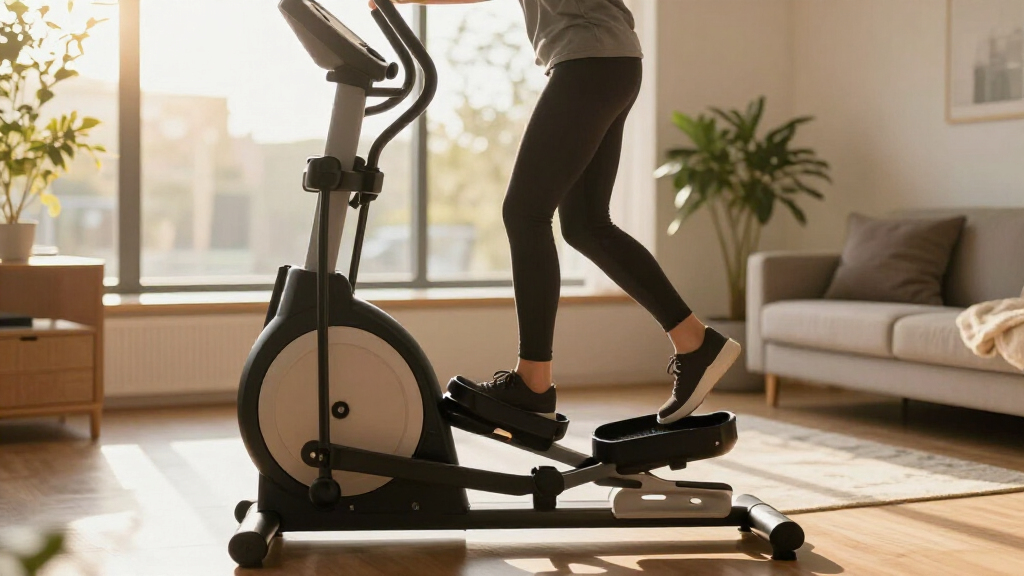
I evaluated each machine through the lens that defines this category: how much workout can you get from how little space. Footprint and folded dimensions came first, because a compact elliptical that doesn’t actually fit your apartment has failed at its one job. Stride length was weighted almost as heavily — a short stride turns an elliptical from a fluid cardio machine into a choppy, unsatisfying pedal motion, so I favored models that preserved 15+ inches of stride despite a small frame. Resistance quality, flywheel weight, and frame stability determined whether each machine could support progressive training rather than just easy spinning.
Beyond the hardware, I compared assembly complexity, noise output, weight capacity, warranty coverage, and price-to-performance ratio. Machines rose in the rankings when they solved a specific buyer problem well — folding flat for storage, supporting taller users, or delivering gym-feel strides at apartment scale — and dropped when a low price came with stability or durability compromises. The ranking reflects who each machine serves best, not raw spec sheets, because a perfect elliptical for a 6’1″ runner is a poor choice for a small-studio renter who stores it under a bed.
Factors to Consider When Choosing Compact Home Elliptical Trainers
Before clicking buy on any of these twelve machines, step back and think about how and where you’ll actually use it. The most common regret in this category isn’t buying a bad elliptical — it’s buying the wrong size and type of elliptical for your body, your space, and your training habits.Measure Your Space Before Anything Else
The stated footprint tells only part of the story, because ellipticals need clearance on all sides — a machine that’s 50 inches long needs roughly 15 inches behind it for your stride and safe dismounting. Measure your intended spot at the machine’s widest rotation point, including where moving arms sweep, and account for ceiling height if you’re tall: elliptical motion lifts your head several inches above standing height. If you plan to fold and store the unit, measure your storage area too, and remember that a folded machine still needs to physically travel there — a 70-pound folded frame is awkward in a narrow hallway. Buyers routinely forget that doorways, elevators, and stairwells also constrain delivery. A machine that fits your living room but can’t make it up your staircase is a return shipment waiting to happen.
Stride Length Determines Whether You’ll Actually Use It
Stride is the spec most buyers underestimate and most regret compromising on. A 12-inch stride forces short, bouncing steps that feel unnatural for anyone accustomed to walking or jogging mechanics, while 18+ inches mimics a natural running gait. As a rough guide, users under 5’6″ can be comfortable at 14–16 inches, average heights do well at 16–18, and anyone over 6 feet should insist on 18 inches or more. The mistake I see constantly is choosing a folding compact model with a 13-inch stride to save eight inches of floor space, then abandoning the machine within two months because the motion never feels right. Some compact designs now offer adjustable strides, which is the best of both worlds if two users of different heights share the machine. Pay for the stride your body needs before you pay for any smart features.
Magnetic Resistance and Flywheel Weight: Ignore the Level Count
Manufacturers love advertising “16 resistance levels” or “24 resistance levels,” but the number of levels tells you nothing about the range between the easiest and hardest setting. What matters is flywheel weight and magnet placement: a heavier flywheel (roughly 13 pounds and up in this category) produces smoother, quieter motion and more meaningful resistance at the top end. Test the question “can the hardest setting challenge me in six months?” — cheap machines often max out at a effort level a moderately fit person outgrows quickly. Conversely, the easiest setting matters for beginners and for recovery days. If a listing doesn’t publish flywheel weight, treat that omission as a warning sign rather than neutral information. Belt-based or friction resistance at this price point is a red flag for noise and maintenance.
Folding Designs: What You Give Up to Save Space
Folding ellipticals solve the storage problem brilliantly, but the hinge that lets a machine fold is also a structural weak point. Every folding design in this comparison sacrificed some combination of rigidity, weight capacity, and stride length versus comparable fixed-frame machines — that’s physics, not poor engineering. The honest question is whether you’ll fold the machine daily or once a month; if it’s monthly, a fixed frame you actually enjoy using beats a folder that becomes a chore to reassemble and quietly stops getting unfolded. Also check the folded dimensions specifically, since “foldable” ranges from sliding halfway shut to genuinely flat storage. Finally, heavier, sturdier folders are harder to move even with transport wheels, so factor in who will be relocating it and how often.
Connectivity, Apps, and the Features You’ll Never Use
Bluetooth pulse sensors, app syncing, and interactive training platforms add cost, and they only pay off if you’ll genuinely use them. If you already subscribe to KinoMap or follow structured workout videos, an app-connected machine adds real accountability. If you’re a headphones-and-podcast person, a basic LCD showing time, distance, and calories does the same job for less money. The middle-ground trap is paying a premium for a touchscreen you could replicate with a phone mount and a free app. Warranty and parts availability deserve equal scrutiny: this category includes newer brands with thin service histories, and a budget machine with no replacement parts pipeline becomes scrap the first time a pedal bearing wears out. A longer warranty from an established brand is often worth more than any software feature.
Weight Capacity and User Height Reveal Build Quality
User weight capacity is the most honest proxy for frame quality in this price range — a 220-pound capacity machine is built with lighter tubing and smaller bearings than a 300-plus-pound one, regardless of what the listing claims about durability. Even if you weigh well under the limit, a higher capacity machine will feel more stable and last longer under daily use. Taller or heavier users should also verify the machine’s listed user height range, since compact ellipticals sometimes quietly cap out around 6 feet. Add your own body weight plus the intensity of your intended use: interval training stresses frames far more than steady-state pedaling. Buying 30–50 pounds of capacity headroom above your weight is one of the cheapest durability upgrades available.
Frequently Asked Questions
Can a compact elliptical really give me an effective workout, or do I need a full-size machine?
Yes, with the right expectations. The cardio benefit of an elliptical comes from sustained elevated heart rate, which a compact machine delivers just as well as a gym unit — the physics of your legs driving magnetic resistance doesn’t care about frame length. What compact machines genuinely sacrifice is stride naturalness and top-end resistance ceiling, which matters for tall users and highly trained athletes more than for general fitness. A 16–18 inch stride at moderate-to-high resistance will challenge most home users indefinitely. The real risk isn’t inadequate equipment; it’s choosing a machine with a stride too short for your height, which makes workouts uncomfortable enough that you stop doing them. Match the machine to your body and a compact elliptical will outperform the full-size gym unit you never visit.
Is a folding elliptical worth it if I have the floor space to leave one set up?
Probably not. Every folding mechanism in this category introduces tradeoffs — reduced frame rigidity, lower weight capacity, and often a shorter stride — and those compromises only make sense if folding solves a real problem for you. If the machine can stay in place permanently, a fixed-frame model at the same price will feel more stable and typically last longer. Folding pays off when you share a small living space, need to reclaim the room for guests or work, or store the machine in a closet between sessions. Be honest about your behavior, though: if folding becomes a hassle, the machine stops getting set up and stops getting used. If you’d fold it less than once a week, buy the fixed frame and accept the footprint.
How much should I spend on a compact home elliptical to get something that lasts?
The realistic durability floor in this category sits around the $250–350 mark for fixed-frame machines, and closer to $300–400 for folding models, because the folding hardware costs money that has to come from somewhere. Below that range, you’ll find machines with lighter flywheels, noisier operation, and weight capacities around 220 pounds that suit light, occasional use — fine for a first machine, risky for daily training. Spending $400–600 buys heavier flywheels, sturdier frames, better warranties, and strides long enough for taller users. Beyond that, you’re mostly paying for connectivity and brand-name polish rather than meaningful mechanical improvement. My advice: budget for the stride length and weight capacity your body needs first, then let features absorb whatever remains, not the other way around.
Will a compact elliptical disturb neighbors in an apartment or people in the next room?
Magnetic resistance ellipticals are among the quietest cardio machines available — most produce a low hum in the 55–65 decibel range, quieter than a normal conversation, and compact models with lighter flywheels are often quieter still. The noise that annoys neighbors isn’t the machine itself; it’s vibration transferring through your floor, which becomes a rhythmic thump in the unit below. A thick rubber or foam mat under the machine solves most of this and also protects your flooring, so factor $30–50 for one into your budget. Periodic tightening of bolts matters too, since a loosened joint develops a squeak or knock within weeks of heavy use. With a mat and basic maintenance, a magnetic compact elliptical is apartment-safe at any hour.
What stride length do I need for my height on a compact elliptical?
As a working rule, riders under about 5’4″ can use a 13–15 inch stride comfortably, people between 5’4″ and 5’10” should target 16–18 inches, and anyone taller than 6 feet needs a full 18 inches or more to avoid a clipped, bouncy motion. Stride that’s too short forces your knees up rather than forward, which reduces the workout’s effectiveness and feels awkward enough to derail consistency. Stride that’s slightly long for a shorter rider is far less problematic — you simply take fuller steps. If two people of very different heights will share the machine, look for an adjustable-stride model like the Niceday, which spans 15.5 to 19 inches. When a listing doesn’t publish stride length, assume it’s short and look elsewhere, because reputable manufacturers always state it.
Conclusion
After comparing all twelve machines, the right choice comes down to which compromise you’re willing to live with. Best overall goes to the Niceday Elliptical, which delivers an adjustable 15.5–19 inch stride and a stable frame at a footprint most compact buyers can accommodate — it’s the machine that least feels like a compromise. Best value belongs to the Dripex with 16 resistance levels, which undercuts better-known brands while covering the fundamentals; the Sunny Health & Fitness upright models are the cheaper fallback for the tightest budgets. The JOROTO with its 18-inch stride and KinoMap support is my premium pick for buyers who want gym-quality motion and interactive training at home. Beginners should start with the YOSUDA Foldable or the ANCHEER 16-inch-stride folder — forgiving resistance curves and simple consoles make them easy to build a habit on, though taller users should upgrade to the ANCHEER 16-inch-stride version for a more natural gait. For specific needs: the THERUN suits small shared spaces needing quiet operation, the 3-in-1 model works for households wanting variety on a budget, and the Cursor fits buyers whose space or height simply can’t accommodate anything larger. Measure your space, match stride to your height, and buy the machine you’ll still be using in a year — not the one with the longest spec sheet.
Fall yard work Picks
leaf blowers
As an affiliate, we earn on qualifying purchases.